 Matsushima Bay Tours
Home › Guides › Is Matsushima Bay Worth Visiting?
Is Matsushima Bay Worth Visiting?
Is Matsushima Bay Worth Visiting? Yes, for anyone planning a Matsushima Bay tour, because a 50-minute boat ride weaves between about 260 pine-covered islands and the temples sit a short walk from the pier. The bay earns its place among Japan's three great views, even though the town itself is thin on charm.
Quick answer The short verdict on a Matsushima Bay day
Yes, Matsushima Bay is worth visiting if you are booking a Matsushima Bay tour. The cruise alone is 50 minutes among some 260 pine-covered islands, 40 minutes from Sendai by train. The waterfront scenery is world class, the town streets less so.
Key takeaways
- The bay cruise is the heart of the day, see the Matsushima Bay cruise day tour from Sendai
- Short on time, the bay walk and temple tour covers the highlights in 2 to 3 hours
- Oyster fans should look at the oyster season private tour
- Compare all options on matsushima bay tours
Is Matsushima worth visiting?
Yes, the bay itself absolutely justifies a day, though you should come for the water and the islands rather than for the town.
The honest answer has two halves. The bay is one of the finest seascapes in Japan. The town around the pier is a strip of souvenir shops and resort hotels. Plan the day around the bay and you will leave happy. Matsushima Bay is counted among the Nihon Sankei, Japan's three great views, and reviewers say it has earned that title for its hundreds of small pine-clad islands. It was also the first bay in Japan accepted into the Most Beautiful Bays in the World association, alongside Ha Long Bay, Mont Saint-Michel and San Francisco. The poet Basho made the bay one of the goals of his journey to the north. That is a lot of reputation riding on one stretch of water, and the islands deliver. What you actually do on a bay day is simple. You ride a boat through the islands, walk the shoreline, visit a great Zen temple and taste oysters in season. None of it is strenuous and all of it fits in one day from Sendai, which is 40 minutes away by train on the JR Senseki Line. The catch is the town itself. Writers describe modern Matsushima as little more than a strip of resort hotels and souvenir shops. If you expect a quiet old village you will be disappointed for about an hour. If you expect a boat trip through one of Japan's great landscapes you will get exactly that. Book one of the Matsushima Bay tours and the day is built around the water, which is where the value sits.
Sources: Discover Sendai, Matsushima Tourism Association.
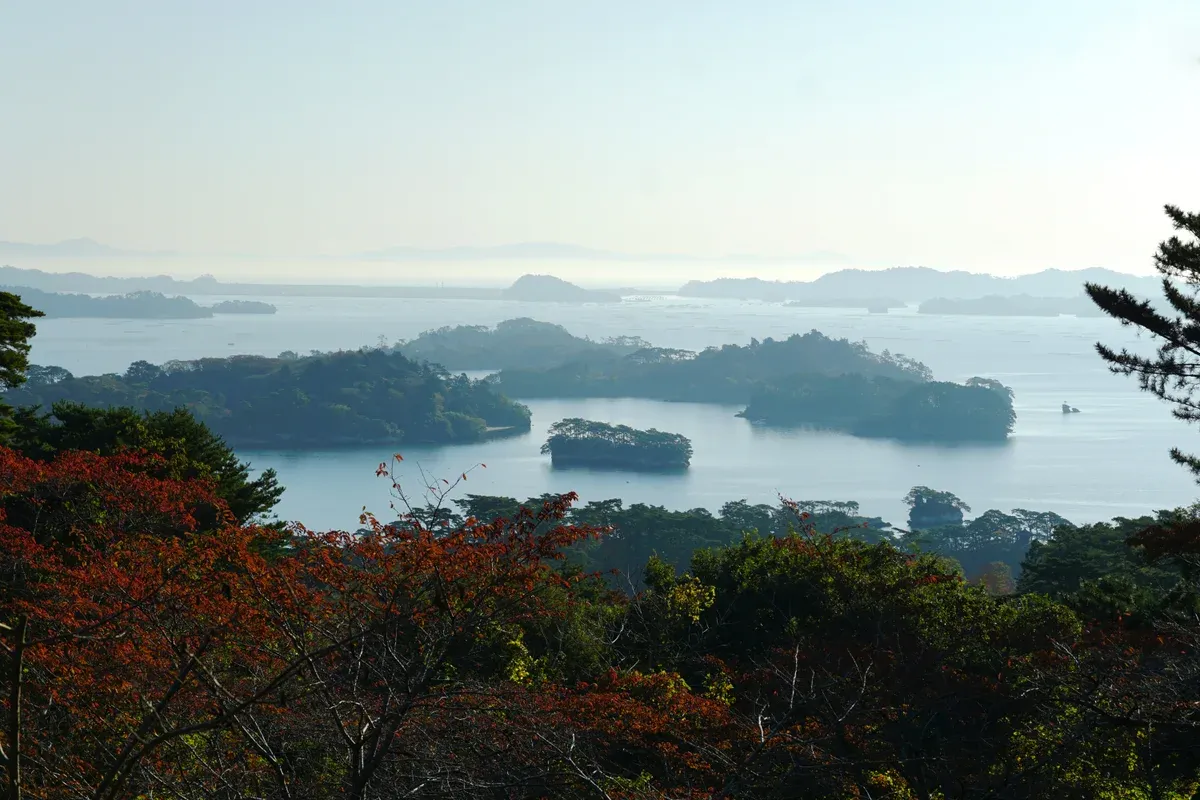
Matsushima Bay from Saigyo Modoshi no Matsu Park. Photo: 663highland, CC BY-SA 4.0, via Wikimedia Commons
Tours That Fit
These are the tours that make the most of a bay day.
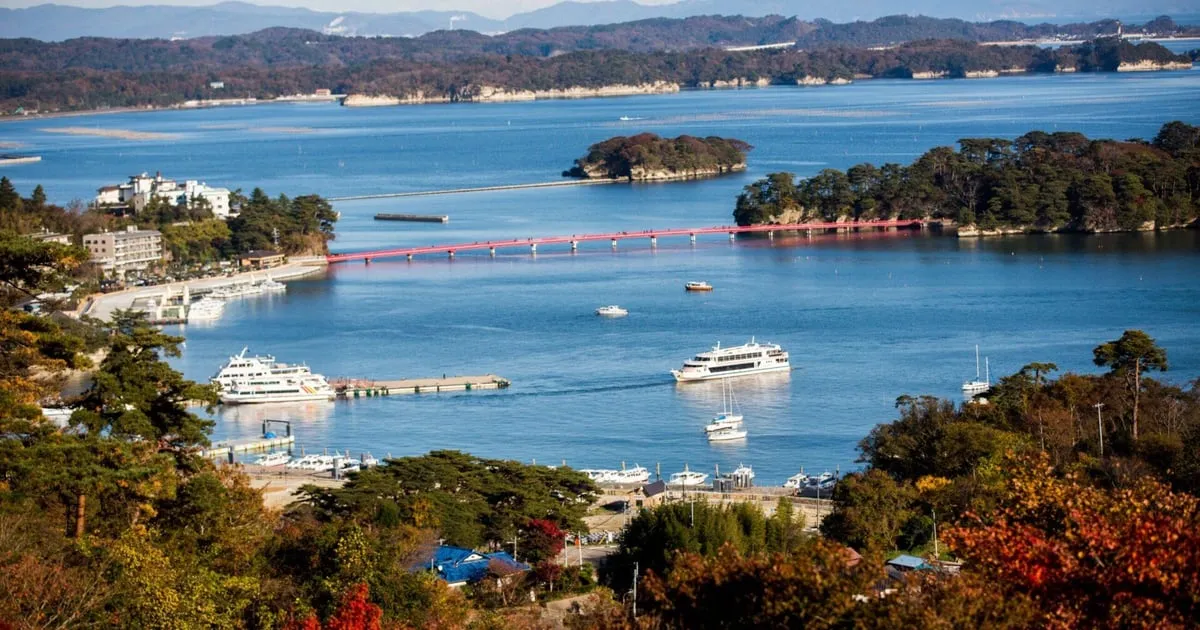
1-Day Tour from Sendai: Matsushima Bay & Scenic Boat Cruise
Small group of 5 max by train, covering Entsuin, Zuiganji, a retro museum, tea at Kanrantei and a 50 minute bay cruise, all fees included.
- Cancellation
- Free cancellation 24h
- Operator
- Machinovate Japan Ltd.
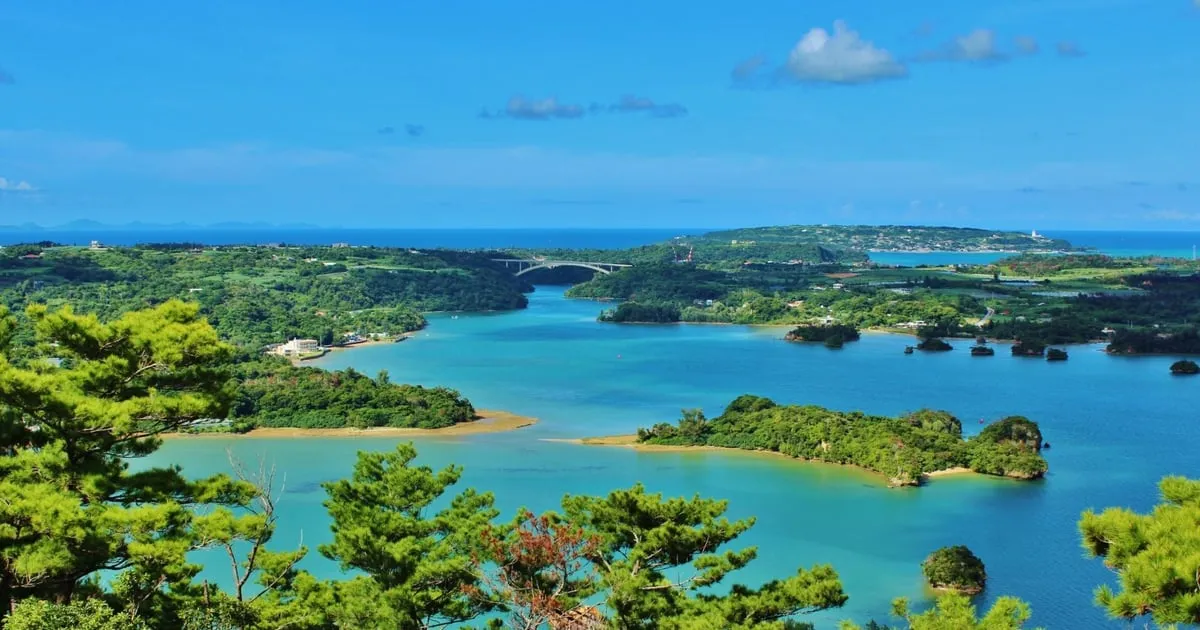
Matsushima: Scenic Bay Walk & Historic Temple Discovery
A private 2-3 hour walking tour of Zuiganji, Godaido and Fukuurajima with an optional Sendai Station departure, capped at 6 people.
- Cancellation
- Free cancellation 24h
- Operator
- DeepExperience, Inc.
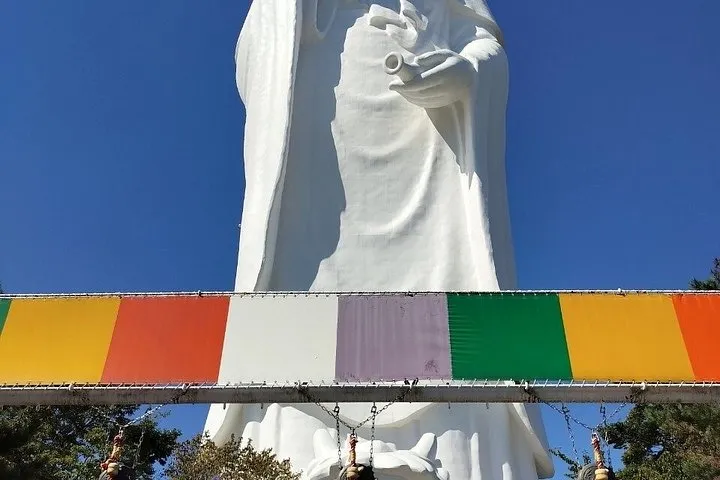
Matsushima Private Tour: Samurai, Oysters & Hotel Transfer
A private 6.5-hour Matsushima day with hotel transfer, bay cruise, temple visits, matcha and an oyster lunch, capped at 4 people.
- Cancellation
- Free cancellation 24h
- Operator
- Kazuyoshi Nagashima
What to do in Matsushima?
Cruise the bay, walk among the islands, visit Zuiganji and the smaller temples, climb to a viewpoint and eat oysters in season.
A Matsushima Bay tour has a natural shape. The boat comes first or last, the temples fill the middle, and food threads through the day. Start with the water. Two scheduled cruises run from the bay, a loop of the islands and a run to Shiogama, both about 50 minutes with adults at $9.54 (¥1,500). Marubun Matsushima Kisen runs its bay loop hourly from 10:00 to 15:00. Boats leave the Central Pier, 7 minutes on foot from Matsushima-Kaigan Station. Then the temples. Zuiganji is the heavyweight, founded in 828 by the Zen priest Jikaku Daishi Enrin and rebuilt by Date Masamune in the early 17th century. Its main hall was designated a national treasure in 1953. Godaido stands next to the pier, free to enter, and is the oldest surviving Momoyama architecture in Tohoku. Kanrantei is a tea house overlooking the bay where a matcha set starts at $3.82 (¥600) on top of the $1.91 (¥300) admission. Then the islands. Oshima is free, takes 20 to 30 minutes to loop and is a 5 to 7 minute walk from the station. Fukuurajima sits across a 252-metre vermilion bridge and holds about 250 kinds of plants. The bridge crossing costs $1.91 (¥300) for adults. If you want all of this arranged for you, the bay walk and temple tour covers the walk and the temples in 2 to 3 hours for $78 per person.
A sample bay day with costs
This is the standard one-day plan from Sendai with every ticket priced. Oysters are at their peak between October and March, so plan a warm bowl if you travel in that window. Anago eel takes over in summer.
| Stop | Time to allow | Cost |
|---|---|---|
| Train from Sendai, JR Senseki Line | 40 minutes each way | JR fare, IC card accepted |
| Zuiganji Temple | 60 to 90 minutes | $4.45 (¥700) |
| Entsuin Temple, open 9:00-16:00 | 45 minutes | $1.91 (¥300) |
| Bay cruise, 50 minutes | 50 minutes plus waiting | $9.54 (¥1,500) |
| Kanrantei tea house, matcha from $2.54 (¥400) | 30 minutes | $1.27 (¥200) plus tea |
| Oshima island walk, free | 20 to 30 minutes | Free |
| Oysters | As long as it takes | Menu prices not stated |
Sources: Matsushima Tourism Association, Discover Sendai, Zuiganji Temple.
How do I get from Sendai to Matsushima Bay?
Take the JR Senseki Line from Sendai, a 40-minute ride to Matsushima-Kaigan Station, from which everything on the waterfront is a short walk.
The train is the simple answer and the one almost every traveller uses. Matsushima-Kaigan Station puts you within walking distance of every stop on the bay day. From the station it is 10 minutes on foot to Zuiganji, 7 minutes to Entsuin and 7 minutes to the Central Pier where the large cruise boats leave. Fukuurajima is 15 minutes on foot. Godaido sits next to the pier. You can do the entire day without a car or a bus. If you would rather not handle tickets and timetables yourself, several tours include transport from Sendai. The Sendai Daikannon and Matsushima tour runs a full 9-hour day by bus for $149.40 per person, and the 8-hour Matsushima Bay cruise day tour from Sendai at $168 per person handles the whole plan for you. Both carry free cancellation up to 24 hours before departure.
Sources: Matsushima Sightseeing Boats, Matsushima Tourism Association.
Is Matsushima a good day trip from Tokyo?
It works as a long day trip from Tokyo if you start early, but it is far easier and more rewarding as a day out of Sendai.
Matsushima appears in searches for Tokyo day trips, and the honest answer is that distance is the obstacle. The bay is 40 minutes from Sendai on the JR Senseki Line, so the smart pattern is to base yourself in Sendai, or sleep near the bay the night before an early boat, and treat Tokyo as a staging point rather than the launch pad. Travellers who do push through from Tokyo get a full but long day. You gain the most by prioritising. Pick the 50-minute bay cruise and Zuiganji as your two non-negotiables, add Kanrantei or Fukuurajima if time allows, and skip the rest. A guided option removes the timetable risk entirely, since the Matsushima Bay cruise day tour from Sendai has the boat, the temples and the transfers built in. One timing note for a tight schedule. Zuiganji's gate opens at 8:30 all year, but closing moves with the seasons, from 5:00 pm in April to September down to 3:30 pm in January and December, with last entry 30 minutes before. In winter the last scheduled bay sailing leaves at 15:00 because the sun sets early. Late starts from Tokyo cost you real sights.
Sources: Matsushima Sightseeing Boats, Matsushima Tourism Association.
What is the Matsushima cruise timetable?
The large Nioumaru boats leave hourly from 9:00 to 16:00 all year, while Marubun's loop runs hourly from 10:00 to 15:00, and in winter the 16:00 sailing is cancelled.
Two operators share the bay. Matsushima Shimameguri runs the big boats and Marubun Matsushima Kisen runs its own loop, plus the Shiogama route. Both fares sit at $9.54 (¥1,500) for adults and $4.77 (¥750) for elementary pupils, with younger children free. The Nioumaru course from the Central Pier is a 50-minute round trip with eight sailings a day, the first at 9:00 and the last at 16:00. In winter the 16:00 sailing is cancelled for the early sunset, so 15:00 is the last boat, and the 9:00 sailing may use a mid-size boat of about 70 seats. Extra sailings run at Golden Week and Obon. No reservation is needed, but booking ahead gives 10 percent off, accepted up to 30 minutes before departure. Marubun's loop from the Rest House, 5 minutes on foot from the station, departs hourly from 10:00 to 15:00, which is the safe window to plan around. Arrive 10 minutes before departure. Marubun also runs a cruise and Kanrantei plan with matcha and grilled sasakamaboko at $12.72 (¥2,000) for adults when discounted. For the full picture by season, see the cruise timetable and booking page.
Which boat should you pick
Both loops see the same islands. The differences are the deck space, the departure point and the extras.
| Boat | Departs | Duration | Fare |
|---|---|---|---|
| Nioumaru large boat, Central Pier | Hourly 9:00 to 16:00, last 15:00 in winter | 50 minutes | $9.54 (¥1,500) adults, $4.77 (¥750) children |
| Marubun loop, Rest House Window 2 | Hourly 10:00 to 15:00 | About 50 minutes | $9.54 (¥1,500) adults, $4.77 (¥750) children |
| Marubun to Shiogama | Scheduled sailings | 50 minutes | $9.54 (¥1,500) adults |
Sources: Matsushima Sightseeing Boats, Matsushima Tourism Association.
Is first class worth it on the Matsushima cruise?
For most travellers no, the $9.54 (¥1,500) second-class ticket is enough, but paying more for an upper deck is worthwhile on a clear warm day.
The fare ladder on Marubun's loop tells you what the upgrade buys. Second class on the first floor is $9.54 (¥1,500) for adults. Green class on the second floor is $13.35 (¥2,100). First class on the third floor is $18.44 (¥2,900). On the Nioumaru, the second-floor deck costs an extra $3.82 (¥600) for adults, sold on board only. What you pay for is a higher seat and a better angle on the islands. The route and the commentary are the same at every level. On a cold or wet day the enclosed lower deck is the better deal and most people are happy there. On a calm sunny day the top deck earns its price, because the islands look best from above the waterline. A practical tip. Children under elementary age cannot use the Nioumaru's second floor and cannot ride alone, so families should budget for lower-deck seats and swap spots on deck at the pier afterwards.
Sources: Matsushima Sightseeing Boats, Matsushima Tourism Association.
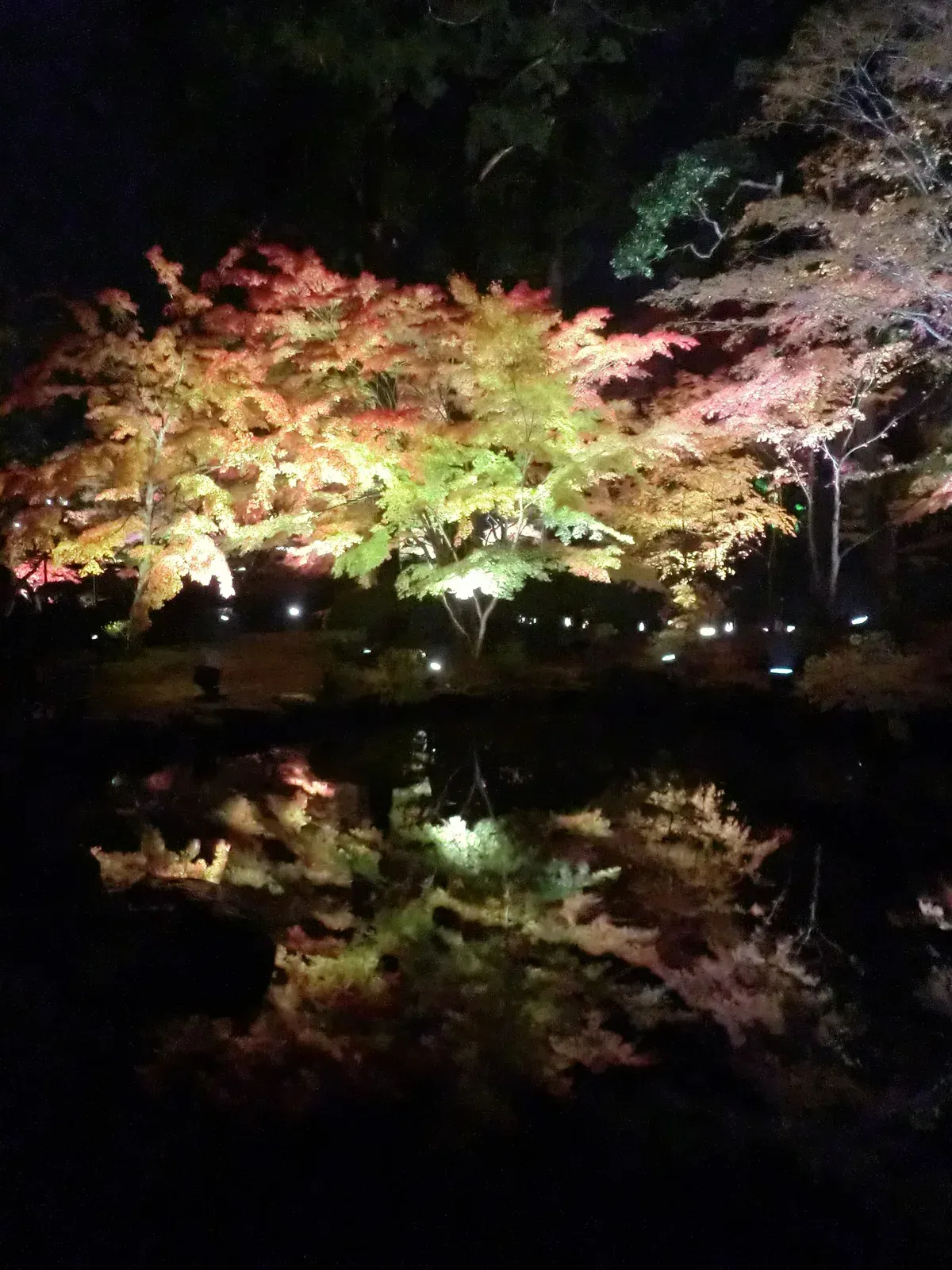
Autumn light-up in Matsushima. Photo: Senngokujidai4434, CC BY 3.0, via Wikimedia Commons
Is it worth going to Matsushima Bay if you dislike tourist towns?
No, if souvenir strips ruin a place for you the town will grate, though the bay itself may still convert you on a guided day that skips the shops.
This is the honest downside every positive review glosses over. The modern town is little more than a strip of resort hotels and souvenir shops. Between the pier and the temples you will pass shops selling the same magnets and rice crackers as each other. Who should skip it. Travellers who want atmospheric old streets, nightlife or a beach day will find none of those here. It is not a swimming destination. It is a looking destination. If your ideal coastal day is a quiet fishing village with no tour buses, the main Matsushima waterfront will disappoint, and you would do better on a longer Tohoku route that bypasses it. What to do instead if you still want the bay. Book a guided day that spends its hours on the water, in the temples and at the far viewpoints, and treat the shop strip as a corridor rather than a destination. The private oyster and samurai tour with hotel transfer, 6.5 hours at $222 per person, keeps you away from the crowds and feeds you at the source in oyster season. For group travel, an 8-hour customizable private vehicle is $1,301 per group of up to 6, which is the bay and Zuiganji option or the oyster season version.
Source: Matsushima Tourism Association.
Where is the best place to see Matsushima Bay?
From the water on a boat, with the Saigyo Modoshi no Matsu Park platform as the best viewpoint on land.
There is no single answer, but there is a ranking. The boat is first, because the 50-minute cruise is the only way to get inside the scattered islands rather than looking at them. Of the four named lookout points around the bay, Sōkanzan is described as offering the best all-round views, a thirty-minute climb on foot or a short taxi ride. On the immediate waterfront, Saigyo Modoshi no Matsu Park is the classic shot. Its viewing platform frames cherry blossoms and the bay islands together, and the park holds over 260 cherry trees. It is 5 minutes by car from Matsushima-Kaigan Station, and the Panorama Line road up to it is closed in winter, so plan around that if you travel in the cold months. For a wider sweep, Ogidani, called the Mysterious View, shows the whole bay and is good for autumn leaves. From the station it is 25 minutes on foot to the trailhead or 5 by car, then 3 minutes up stairs. In the evening, Kanrantei and the Zuiganji approach are lit during the autumn light-up period, and the Twilight Cruise is timed to sunset, running daily for 60 minutes at $9.54 (¥1,500) for adults.
Sources: Matsushima Sightseeing Boats, Matsushima Tourism Association.
What is Matsushima famous for?
Matsushima is famous for its roughly 260 pine-covered islands, its rank as one of Japan's three great views, and Zuiganji temple.
Three things carry the name. First the islands, the small pine-clad islets scattered across the bay, about 260 of them by the tourist association's count. Second the title, because Matsushima stands alongside Miyajima and Amanohashidate as one of the Nihon Sankei, Japan's three great views. Third the temples, above all Zuiganji, rebuilt by Date Masamune in the early 17th century on foundations laid in 828. There is a literary layer too. Basho came here on his journey to the north, and the islands have drawn painters and poets for centuries. Food is the modern fourth pillar. Oysters are the bay's signature, at their peak between October and March, with anago eel taking over in summer. One oddity worth knowing before you go. Godaido's Five Wisdom Kings are shown only once every 33 years. Visit for the building and the bridge, not the statues.
Source: Matsushima Tourism Association.
Is Matsushima Bay worth visiting in winter?
Yes, winter is oyster season and the bay is at its best, but the short days cut the last boat to 15:00 and some viewpoint roads close.
Winter is a trade. You lose daylight and you gain the single best food reason to come. On the losing side, the 16:00 Nioumaru sailing is cancelled because the sun sets early, so the last boat is 15:00. The Panorama Line road to Saigyo Modoshi no Matsu Park is closed in winter. Zuiganji closes at 3:30 pm in January and December. Plan a morning arrival and you lose almost nothing. On the winning side, oysters are at their peak between October and March. Marubun runs a Kaki-nabe oyster hot pot cruise from November to late March, plus a New Year's Day sunrise cruise. Indoor temple time suits cold weather, and the bay's muted winter light photographs well. Fukuurajima's bridge hours shrink to 8:30 to 16:30 from November to March, so check the clock before you set off across.
Sources: Matsushima Sightseeing Boats, Matsushima Tourism Association.
How do you get the most from a Matsushima Bay day?
Arrive in the morning, ride the first convenient boat, then stack the temples and viewpoints around it and finish with oysters.
The bay rewards a simple order. Do the water first, the culture second, the food last. Book the boat ahead to take 10 percent off the fare, accepted up to 30 minutes before departure. Buy the $9.54 (¥1,500) second-class ticket unless the weather begs for the top deck. After the cruise, walk 10 minutes to Zuiganji before its afternoon closing time, which moves seasonally, then duck into Entsuin next door, open 9:00 to 16:00 with adults at $3.18 (¥500). Kanrantei's tea and view make a good late-afternoon stop. Two upgrades worth knowing. First, if you want a human to hold the plan together, the private guided tour with a national licensed guide does exactly that. Second, in the autumn light-up window the Twilight Cruise and the illuminated Zuiganji approach turn the same bay into an evening sight, so a late start can work then where it would fail in summer. Where you sleep matters if you want an early boat. Komatsukan Kofu-tei sits in front of the bay with hot-spring baths, a free shuttle from JR Matsushima Kaigan station and a 10-minute walk to Godaido. Hotel Matsushima Taikanso is 900 metres from Entsuin and about 28 km from Sendai Airport. Staying local turns a rushed day trip into a relaxed one.
Sources: Matsushima Sightseeing Boats, Matsushima Tourism Association.
Questions Travellers Ask
Is Matsushima worth it?
Yes, for the bay itself. A 50-minute cruise among about 260 pine islands, a national treasure temple and oysters in season justify the 40-minute train ride from Sendai. See the full day plan in What to do in Matsushima.
Is it worth going to Matsushima Bay?
It is worth going if a boat trip through one of Japan's three great views is what you want. It is not worth going for the town streets, which are mostly souvenir shops. Plan around the water and you will not regret it.
Is the Matsushima cruise worth it?
The cruise is the single best-value ticket in the bay at $9.54 (¥1,500) for a 50-minute loop, and the Matsushima Bay cruise day tour from Sendai includes it.
Is Zuiganji worth visiting?
Yes. Its main hall was designated a national treasure in 1953, the temple was rebuilt by Date Masamune in the early 17th century, and admission is $6.36 (¥1,000) for adults. Allow 60 to 90 minutes.
Is Fukuurajima worth it?
For $1.91 (¥300), yes. The 252-metre vermilion bridge walk is a fine view in itself and the island holds about 250 kinds of plants on a short loop. It is 15 minutes on foot from the station.
Is Oku Matsushima worth it?
It is a quieter extension of the same bay. Boats link Matsushima and Oku-Matsushima on Sundays, with a change of boat for the Sagakei gorge, and the cruise desk at Aomina is open 8:15 to 17:00 daily. Fares are not stated, so ask at the desk.
Is Matsushima worth visiting, what do people say on Reddit?
Community opinion mirrors the reviews elsewhere. Visitors say the bay has earned its Nihon Sankei designation for the hundreds of islands, while agreeing the town itself is commercial. The islands and the boat are what people praise.
Is it worth going to Zuiganji?
Yes, and it pairs naturally with the bay. It is a 10-minute walk from Matsushima-Kaigan Station, the gate opens at 8:30 all year, and closing runs from 5:00 pm in summer to 3:30 pm in midwinter.
More Guides
- How to Get to Matsushima Bay from Sendai and Tokyo
How to get to Matsushima Bay in 2027: 40 minutes by train from Sendai, the Shinkansen from Tokyo, the stations and the boats. Plan your trip.
- What Are the Matsushima Bay Islands?
About 260 pine islets, four classic viewpoints and a 50-minute loop cruise. See the Matsushima Bay islands in 2027: plan your boat day.
- When and Where to Eat Matsushima Bay Oysters
Matsushima Bay oysters in 2027: the October to March season, the grilled oyster huts and the fish market. Plan your oyster lunch now.