 Matsushima Bay Tours
Things to Do in Matsushima: What to See in One Day
The best things to do in Matsushima in one day are the bay cruise, Zuiganji Temple, Godaido Hall, Entsuin Temple, matcha at Kanrantei, the walk over the red Fukuura bridge to Fukuurajima and a hilltop view from Saigyo Modoshi no Matsu park. Matsushima Bay in Miyagi Prefecture holds about 260 pine-topped islands and counts as one of the Three Views of Japan, so most people come for the water first and the temples second. The whole town sits in a tight pocket on the shore, 25 to 40 minutes by train from Sendai, which makes it one of the easiest day trips in Tohoku. You can walk the whole core in a day on your own, or hand the logistics to one of the top Matsushima Bay tours and let a guide handle the train, the tickets and the order of the stops.
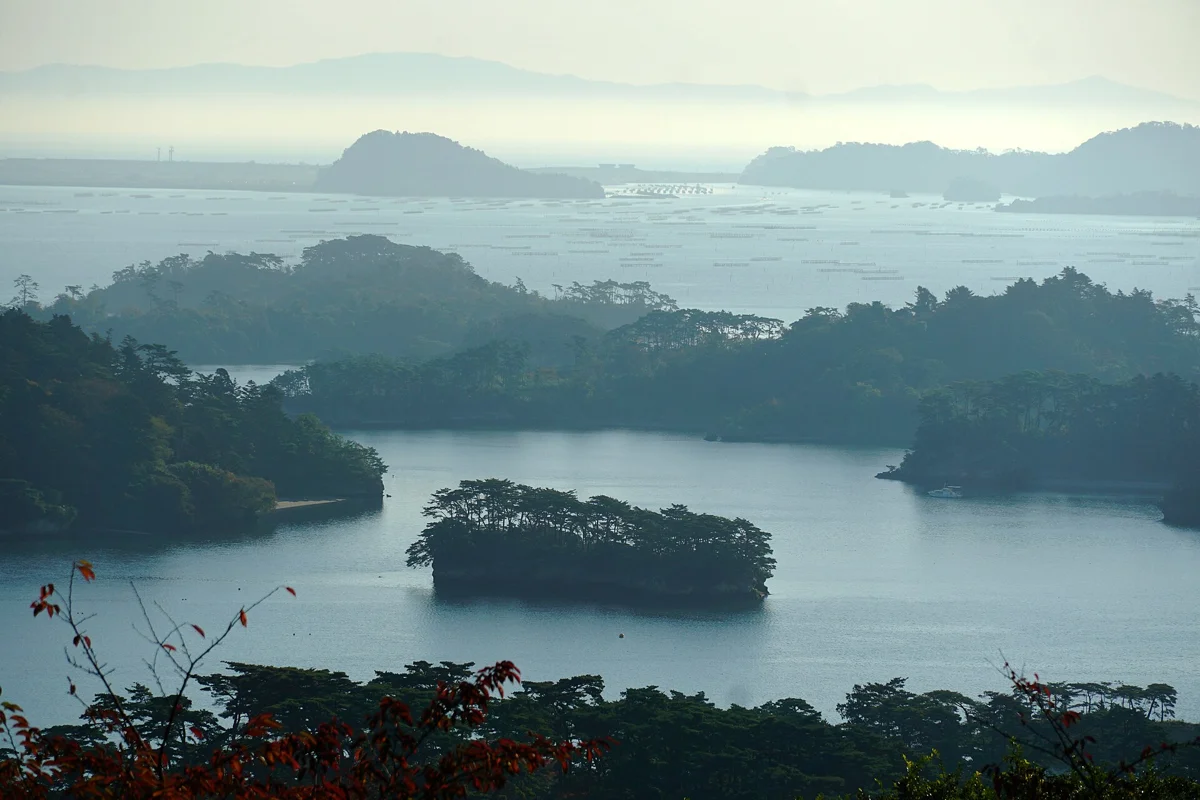
The bay from Saigyo Modoshi no Matsu park. Photo: 663highland, CC BY-SA 4.0, via Wikimedia Commons.
Quick answer One day in Matsushima: the sights, the order to see them and what each one costs
A full day in Matsushima covers the 50-minute bay cruise, Zuiganji, Godaido, Entsuin and Kanrantei in the town core, plus Fukuurajima over the red bridge if your legs hold out. Every one of those sits within about ten minutes on foot of Matsushima-Kaigan Station. Doing it yourself costs around 4,220 yen ($26.71) with the train from Sendai, entries, matcha and the cruise. Oysters run from November to March, and the Toro Nagashi lantern festival with fireworks lands on 17 August each year. If you would rather not juggle tickets, a guided day trip from Sendai folds the train, the entries and the cruise into one price.
Key takeaways
- The 50-minute loop cruise past the islands is the one thing almost everyone does, and it starts next to Godaido. See how the boats compare in our Matsushima Bay cruise guide.
- The Matsushima Bay Day Tour from Sendai with a Scenic Boat Cruise bundles the train, all entry fees, matcha at Kanrantei and the cruise into one price.
- Zuiganji, the Date family temple with a National Treasure main hall, deserves the longest stop of any sight in town. Our Zuiganji Temple guide has the full detail.
- You will not see Date Masamune's mausoleum here. Zuihoden is in Sendai, about half an hour away, not in Matsushima.
- Oyster season runs roughly November to March, and the oyster hut serves all-you-can-eat grilled oysters for 40 minutes. More in our Matsushima oysters guide.
Which Day Suits You
If you want the whole shore covered in one day without booking anything yourself
Take the Matsushima Bay Day Tour from Sendai with a Scenic Boat Cruise, an 8-hour small-group trip with the train, entries, matcha and the cruise included.
If you are based in Matsushima overnight or want a shorter outing
The Matsushima Walking Tour: Zuiganji, Godaido and Fukuurajima covers the three headline sights on foot in 2 to 3 hours.
If you travel in oyster season and lunch matters as much as the views
The Matsushima Private Tour with an Oyster Lunch, Bay Cruise and Hotel Pickup adds a fresh oyster lunch, matcha and door-to-door car transport.
If you arrive on a cruise ship at Sendai-Shiogama Port
The Matsushima Private Shore Excursion from Sendai-Shiogama Port runs a private car timed to your ship, with free time on the waterfront.
If you have more than a day and want Sendai too
The Sendai and Matsushima Full-Day Private Tour with a Licensed Guide gives you a licensed guide for 6 hours, or the Matsushima and Sendai Two-Day Private Tour from Tokyo covers both cities over two days.
What Matsushima Is Famous For
Matsushima Bay holds about 260 small islands topped with pine trees, and that cluster of green rocks on grey water is the whole reason the town is famous. Together with Amanohashidate in Kyoto Prefecture and Miyajima in Hiroshima Prefecture, it forms the Nihon Sankei, the Three Views of Japan, a grouping that goes back to the Edo-period scholar Hayashi Shunsai. That title carries real weight in Japan, and it is why the bay fills with tour groups from Tokyo and Sendai on any fine weekend.
Two names shaped what you see today. The poet Matsuo Basho came here in 1689 on the journey he wrote up as Oku no Hosomichi, The Narrow Road to the Deep North, and the bay appears in the book. Date Masamune, the first lord of the Sendai domain, rebuilt Zuiganji in 1609 and Godaido in 1604, and the Date family left their mark on most of the temples along the shore.
One common mix-up to clear early: Zuihoden, the ornate mausoleum of Date Masamune, stands in Sendai, not in Matsushima.
There is a quieter story too. In the 2011 Great East Japan Earthquake the islands are widely reported to have broken the force of the tsunami before it reached the town. The shore streets flooded, but the damage was lighter than on the open coast nearby, and people sheltered on the higher temple grounds of Zuiganji.
The Bay Cruise
The cruise is the anchor of any day here and the closest you get to the islands themselves. Two companies run sightseeing boats. Matsushima Shimameguri Kankosen runs a loop of about 50 minutes that starts and ends at the pier next to Godaido, with departures roughly every hour from about 9:00 and a last boat about 16:00, about 15:00 from November to March.
Marubun Matsushima Kisen runs the Basho course, a one-way sailing between the Matsushima pier and Marine Gate Shiogama through shallower water closer to more islands, with sailings about 9:00 to 15:00.
Practical notes that matter. Gulls follow the boats and passengers feed them shrimp snacks sold on board, which children love. Part of the loop runs into more open water where the boat can rock, so sit inside if you are prone to seasickness.
High wind cancels or cuts trips short, which is not rare in typhoon season, otherwise the boats run year-round. The pier is a 6 to 7 minute walk from Matsushima-Kaigan Station. A popular variation is to ride the Marubun boat one way to Marine Gate Shiogama, walk 5 to 10 minutes to Hon-Shiogama Station and take the train back, which our Matsushima Bay cruise guide covers in full.
The table below compares the loop cruise and the Basho course, using fares published by the boat companies.
| Cruise | Route | Fares | Schedule |
|---|---|---|---|
| Matsushima Shimameguri Kankosen loop | About 50 minutes, starts and ends at the pier next to Godaido | 1,500 yen ($9.49) adults, 750 yen ($4.75) children 6 to 11, preschool free, upper-deck Green seats 600 yen ($3.80) extra | Roughly hourly from about 9:00, last boat about 16:00, about 15:00 November to March |
| Marubun Matsushima Kisen Basho course | About 50 minutes, one-way Matsushima pier to Marine Gate Shiogama, shallower water closer to the islands | Standard 1,500 yen ($9.49), Green room 2,100 yen ($13.29), first-class 2,900 yen ($18.35), children half | Sailings about 9:00 to 15:00 |
Almost every guided listing includes this cruise, including the oyster lunch tour and the bus tour, because a day in Matsushima without the water misses the point.
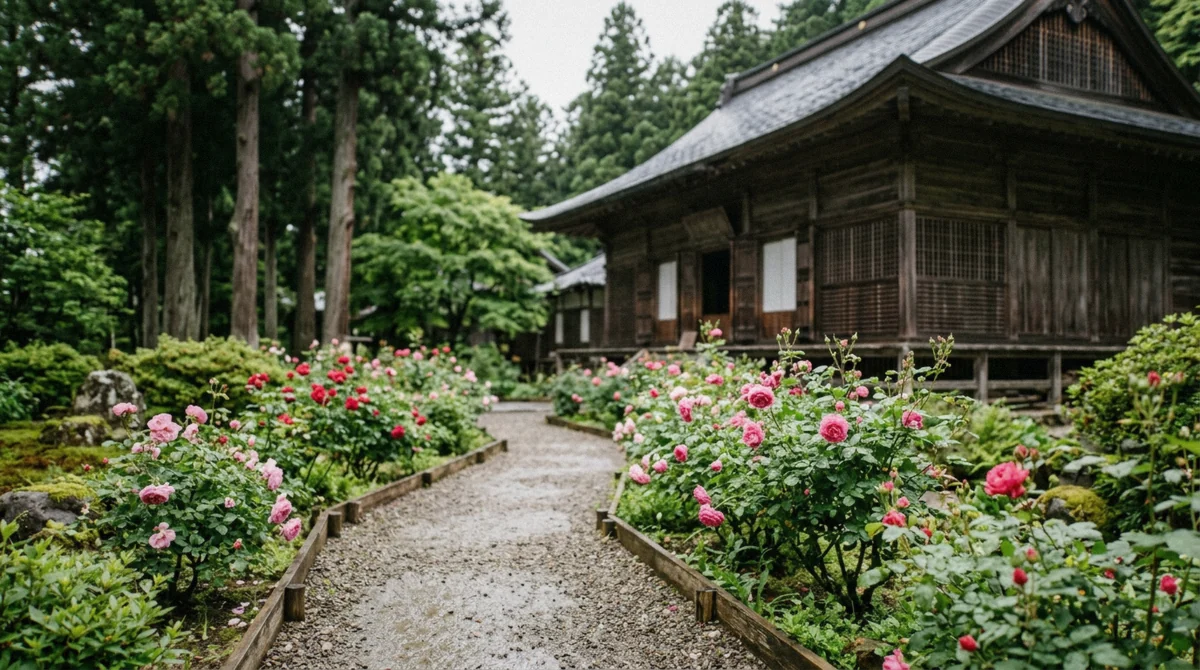
Entsuin is called the rose temple for its garden. Illustrative image.
Zuiganji Temple
Zuiganji is the most important sight in town and deserves the longest single stop. It is a Zen temple of the Date family, rebuilt by Date Masamune in 1609, and its main hall is a National Treasure. The approach runs under a corridor of tall cedar trees, with caves cut into the rock along one side that once served as memorial chambers.
Give it around 40 minutes, the time the walking tour and the private listings schedule for it.
Entry is 1,000 yen ($6.33) for adults and 500 yen ($3.16) for children, a fee the temple raised on 1 April 2026. It opens at 8:30 and closes at 15:30 in December and January, 16:00 in February and November, 16:30 in March and October, and 17:00 from April to September, with last entry 30 minutes before closing. The Seiryuden treasure hall on the grounds is wheelchair accessible.
The temple is 7 minutes on foot from Matsushima-Kaigan Station. Our Zuiganji Temple guide covers the art and the caves in more depth.
Godaido Hall and the Gap-Plank Bridges
Godaido is the small red hall on its own islet right next to the pier, rebuilt by Date Masamune in 1604, and it is the postcard sight of Matsushima. You reach it over two short bridges whose floor planks have open gaps between them, so you watch your step and see the water through the boards as you cross. It is free, it takes little more than a photo stop, and the tours that include it allow about 30 minutes for the hall and the pier area together.
Location does the rest. Godaido sits 7 to 8 minutes on foot from the station, beside the cruise pier, so you will pass it several times in a day no matter how you plan things. Early light on the hall with the islands behind it is the shot most people come for.
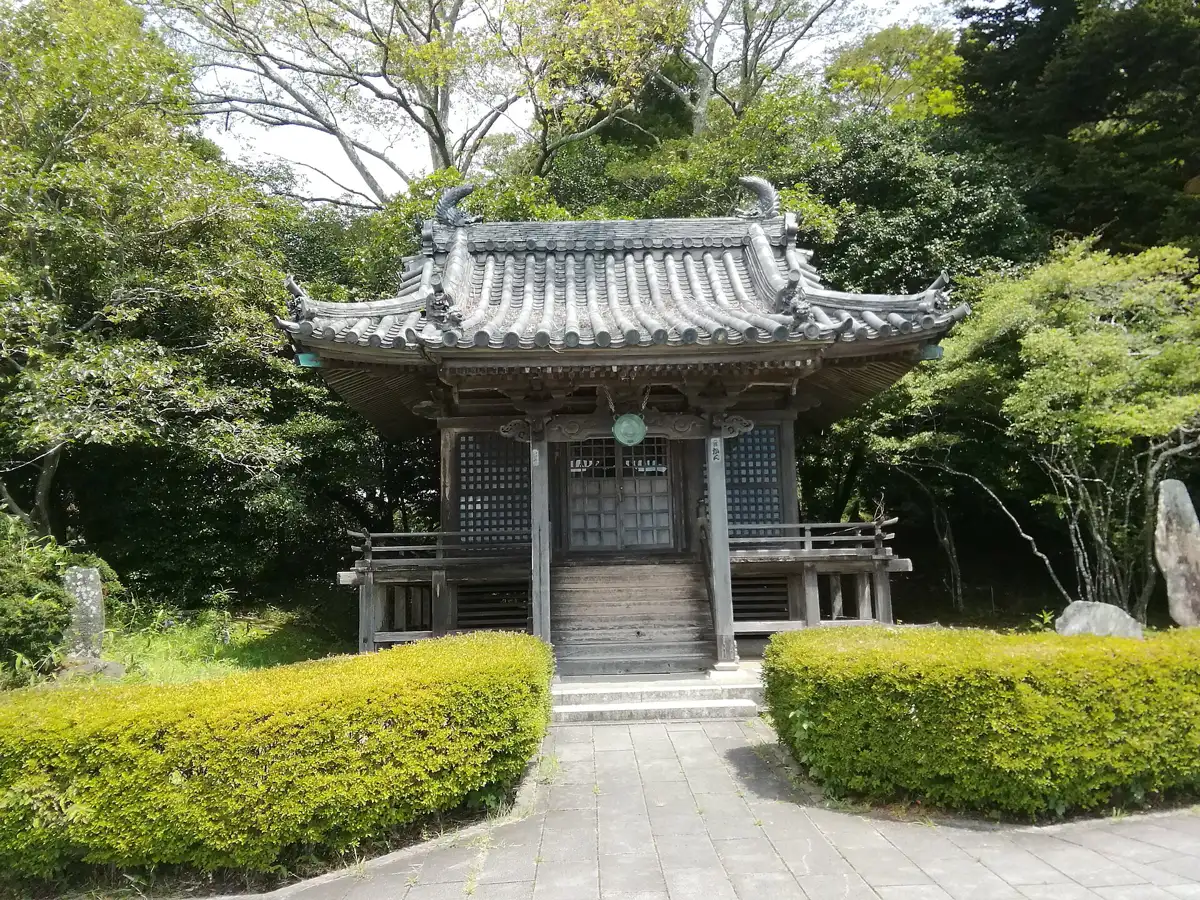
The Benzaiten hall on Fukuurajima. Photo: 妖精書士, CC0, via Wikimedia Commons.
Entsuin Temple and the Rose Garden
Entsuin, founded in 1647 as the memorial temple of Date Mitsumune, the grandson of Date Masamune, is called the rose temple for its rose garden, and it adds moss and rock gardens to the mix. Entry is 500 yen ($3.16) for adults and 300 yen ($1.90) for children. It opens 9:00 to 16:00 from April to November and 9:00 to 15:30 from December to March, and the tours allow about 40 minutes for a visit.
The temple has a second season worth planning around. Autumn leaves at Entsuin and Zuiganji peak late October to mid November, and Entsuin runs a night light-up from late October to mid November, 17:30 to 21:00, at 1,300 yen ($8.23) for adults. If your day stretches into the evening in that window, this is the best reason to stay after dark.
Kanrantei and Matcha
Kanrantei is a teahouse with an unusual history. It began at Toyotomi Hideyoshi's Fushimi Castle, was given to Date Masamune and later moved to the Matsushima shore, where it now sits facing the bay. Entry is 200 yen ($1.27), and a matcha and sweet set is served inside, though the set price is not published.
The day tour schedules about 30 minutes here and includes the matcha with zunda mochi in its fare.
It is the most restful stop of the day. You sit on tatami, look out over the water through the open front of the building, and let the crowds move past below. Pairing it with the cruise pier and Godaido makes an easy loop from the station.
Fukuurajima Over the Red Bridge
Fukuurajima is a wooded island with walking paths and a lookout, reached on foot over the 252-metre red Fukuura bridge. The bridge toll is 200 yen ($1.27), cash only. The island opens about 8:00 to 17:00, to about 16:30 in winter, and the listings allow about 30 minutes for the crossing and the paths.
The island paths are uneven, so wear shoes with a grip, and note the walking tour that ends here warns it is not suitable for limited mobility. The payoff is a raised overlook over the bay from a different angle than the shore, and the bridge itself with the islands behind it is one of the most photographed views in town. The Matsushima Walking Tour: Zuiganji, Godaido and Fukuurajima finishes near the bridge, close to the cafés and the pier.
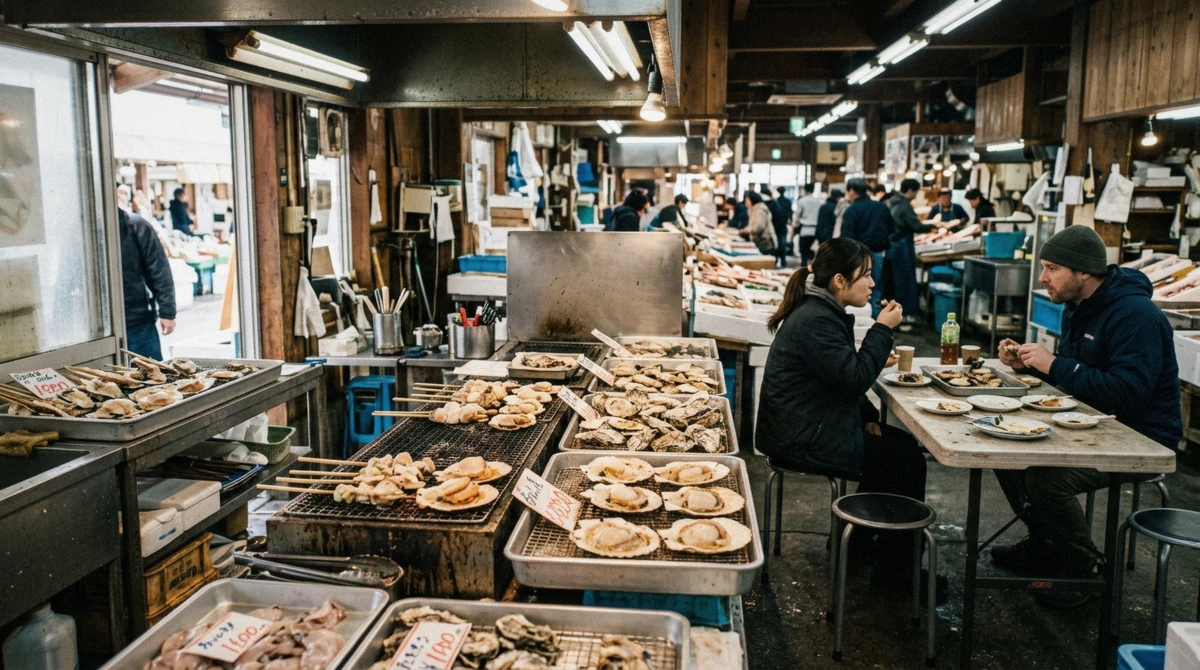
Grilled shellfish at a market counter. Illustrative image.
The Four Great Views and Saigyo Modoshi no Matsu Park
Matsushima has a set of named hilltop viewpoints called the Four Great Views, or Shidaikan, chosen around 1820. Otakamori on the east side gives a 360-degree panorama after a short hike. Tamonzan, 55.6 metres high, looks across to Shiogama harbour.
Tomiyama and Ogidani frame the bay spread out like an open folding fan. These need bus or taxi time, so most one-day visitors pick one instead.
That one is usually Saigyo Modoshi no Matsu park, the easiest high viewpoint from the town. It is a free hilltop park with about 260 cherry trees and a deck over the bay. Cherry blossom there peaks mid to late April, which makes it the single best free view of the season.
Legend has it the poet Saigyo turned back here, which is where the name comes from.
The Fish Market and Oysters
The Matsushima fish market, Matsushima Uogashi, sits by the shore and runs roughly 8:00 to 17:00, with food counters until mid-afternoon. Around it, seafood restaurants serve anago, conger eel, rice bowls. The day tour stops here for lunch, with food paid at your own cost, and grilled sasakamaboko, the bamboo-leaf-shaped fish cake that is a Miyagi speciality, is something you can grill yourself at some shops.
Oysters are the winter draw. The season runs roughly November to March, and the tourism association operates a seasonal oyster hut, a kaki-goya, from about early November to early March: 40 minutes of all-you-can-eat grilled oysters for 3,500 yen ($22.15) for adults and 1,750 yen ($11.08) for children. The Matsushima Oyster Festival is held in early February at the Matsushima-Kaigan Green Plaza.
Zunda mochi, rice cake under a sweet paste of mashed edamame, is the other local bite to try, and our Matsushima oysters guide goes deeper on the season.
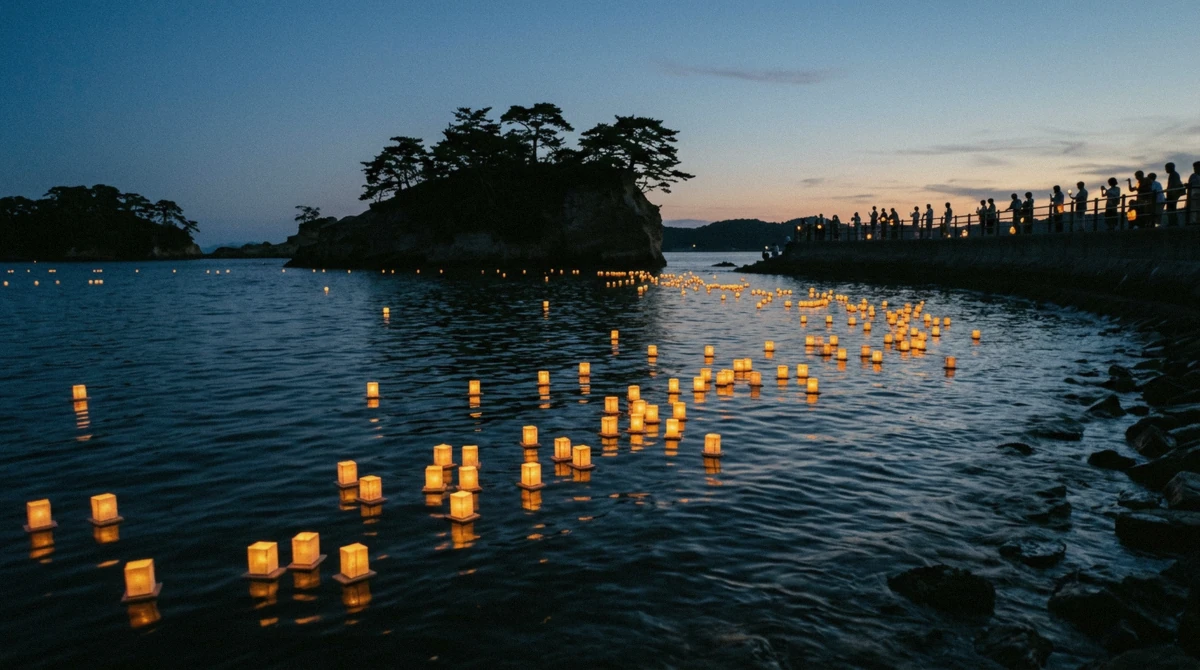
The lantern festival on 17 August. Illustrative image.
The Toro Nagashi Lantern Festival
If your dates line up, the Matsushima Toro Nagashi lantern festival is held every year on 17 August. Lanterns are floated on the bay in memory of the dead, and the evening closes with about 8,000 fireworks over the water. It turns a daytime bay into a night-time event without changing your itinerary by a single stop.
Mid-August is also the warmest stretch of the year here, with an average high of 28.2°C (83°F) and a low of 21.6°C (71°F). Bring water and plan the temples for the morning, because the festival gives you a reason to stay into the evening anyway.
A One-Day Walking Route from Matsushima-Kaigan Station
Take the JR Senseki Line from Sendai to Matsushima-Kaigan, 25 to 40 minutes and 410 yen ($2.59) one way, with rapid trains at the fast end. Do not get off at JR Matsushima Station on the Tohoku Main Line, which is a different station further from the bay. From Matsushima-Kaigan, everything in the core is walkable.
The route below starts at the station and runs the stops in an order that front-loads the temples before the cruise crowds build.
Walking minutes below come from the station distances published for each sight and the stop times the guided tours schedule.
| Stop | Entry | Time to allow | Note |
|---|---|---|---|
| Zuiganji Temple | 1,000 yen ($6.33) adults | About 40 minutes | 7 minutes on foot from the station, opens 8:30 |
| Entsuin Temple | 500 yen ($3.16) adults | About 40 minutes | Close to Zuiganji, opens 9:00 |
| Godaido Hall | Free | About 30 minutes with the pier area | 7 to 8 minutes on foot from the station |
| Bay cruise | 1,500 yen ($9.49) adults | About 50 minutes on the water | Pier 6 to 7 minutes from the station, boats from about 9:00 |
| Kanrantei matcha | 200 yen ($1.27), matcha set priced separately | About 30 minutes | Next to the pier, a rest stop |
| Fukuurajima | 200 yen ($1.27) bridge toll, cash only | About 30 minutes | Opens about 8:00 to 17:00 |
| Saigyo Modoshi no Matsu park | Free | not stated | Hilltop above the town, cherry peak mid to late April |
A workable order: Zuiganji at opening, then Entsuin, then down to Godaido and the cruise, then matcha at Kanrantei, then the red bridge to Fukuurajima, and Saigyo Modoshi no Matsu park last if the legs are willing. The fish market fits wherever hunger lands. Nothing here is more than about ten minutes on foot from the station, which is why the day works without a car.
What a Day on Your Own Costs
The figures below are the published fares and entry fees for the sights in the walking route, with the train fare from the JR Senseki Line. Yen are totalled first, then converted at the rate used across this site, 1 USD = 158 yen.
| Item | Cost | Note |
|---|---|---|
| Train, Sendai to Matsushima-Kaigan return | 820 yen ($5.19) | 410 yen ($2.59) each way |
| Zuiganji entry, adult | 1,000 yen ($6.33) | Children 500 yen ($3.16) |
| Entsuin entry, adult | 500 yen ($3.16) | Children 300 yen ($1.90) |
| Kanrantei entry | 200 yen ($1.27) | Matcha set priced separately, not published |
| Fukuura bridge toll | 200 yen ($1.27) | Cash only |
| Bay cruise, adult | 1,500 yen ($9.49) | Loop cruise, children 750 yen ($4.75) |
| Lunch at the fish market | not stated | Counters priced individually |
Sightseeing entries plus the cruise come to 3,400 yen ($21.52) per adult, and with the return train the day lands at 4,220 yen ($26.71) before food. Carry cash for the Fukuura bridge and small shops. Against that, the Matsushima Bay Day Tour from Sendai with a Scenic Boat Cruise costs $167 per person and folds in the train, every entry, the cruise and the matcha with zunda mochi.
Which Guided Tours Cover Which Sights
The tours compared here split cleanly into full-service days and guide-only walks. The table maps the sights each one covers, with prices as the listings give them. Use it to match a listing to the stops above rather than reading each page in turn.
| Tour | Price | Cruise | Sights covered |
|---|---|---|---|
| Matsushima Bay Day Tour from Sendai with a Scenic Boat Cruise | $167 per person | Yes, 50 minutes | Entsuin, Zuiganji, Godaido, Kanrantei, fish market lunch stop, cruise |
| Sendai and Matsushima Half-Day Private Tour with a Licensed Guide | $106.89 per person | No | Your choice of 2 to 3 sites |
| Sendai and Matsushima Full-Day Private Tour with a Licensed Guide | $142.51 per person | No | Your choice of 3 to 4 sites |
| Matsushima Private Guided Tour with a Local Licensed Guide | $106.43 per person | Optional, about 1,500 yen paid on top | Zuiganji, Entsuin, Fukuurajima, street food |
| Matsushima Walking Tour: Zuiganji, Godaido and Fukuurajima | $78 per person | No | Zuiganji, Godaido, Fukuurajima |
| Matsushima Private Tour with an Oyster Lunch, Bay Cruise and Hotel Pickup | $222 per person | Yes, about an hour | Godaido, Kanrantei, Zuiganji, Entsuin, Fukuura bridge, oyster lunch, hotel pickup |
| Sendai Daikannon, Jogi Temple and Matsushima Bay Cruise Bus Tour | $148.99 per person | Yes, 50 minutes | Sendai Daikannon, Jogi Temple, the cruise, fish cake grilling |
| Matsushima Private Shore Excursion from Sendai-Shiogama Port | $428 per group up to 4 | No | Free time on the waterfront, temples, shops and oysters in season |
| Matsushima and Sendai Two-Day Private Tour from Tokyo | $1,583 per group up to 6 | Yes | Day 1: cruise, Zuiganji, Godaido. Day 2: Sendai castle hill and city |
A quick read of that grid: the day tour from Sendai is the only one covering every shore sight with entries and the cruise in one price, which is why it carries the editor's pick on this site. The private walking formats buy the guide only, so the fares, entries and cruise from the cost table above are added at the gate. For how the boats themselves differ, our Matsushima Bay cruise guide is the next read, and where to stay in Matsushima covers the hilltop and waterfront hotels if one day turns into two.
Getting here from the capital is its own question, so see Tokyo to Matsushima for the rail options.
Questions and Answers
What are the best things to do in Matsushima?
The bay cruise, Zuiganji Temple, Godaido Hall, Entsuin Temple, matcha at Kanrantei and the walk to Fukuurajima are the core, with Saigyo Modoshi no Matsu park as the best free viewpoint. All of them sit within about ten minutes on foot of Matsushima-Kaigan Station. Oysters from November to March and the Toro Nagashi festival on 17 August are the seasonal extras.
What is Matsushima famous for?
It is one of the Three Views of Japan, a bay of about 260 pine-topped islands. The poet Matsuo Basho visited in 1689 and wrote about it in Oku no Hosomichi, and Date Masamune rebuilt Zuiganji in 1609 and Godaido in 1604. His mausoleum, Zuihoden, is in Sendai, not here.
What should I do on a day trip to Matsushima?
Arrive on the Senseki Line at Matsushima-Kaigan, walk to Zuiganji and Entsuin in the morning, then do Godaido and the 50-minute bay cruise, matcha at Kanrantei and the red bridge to Fukuurajima after lunch. The whole loop is walkable, and entries plus the cruise and the return train come to 4,220 yen ($26.71) per adult. Guided options bundle the same stops, starting with the Matsushima Bay Day Tour from Sendai with a Scenic Boat Cruise.
How much time do you need in Matsushima?
One full day covers the bay cruise, both major temples, Kanrantei and Fukuurajima comfortably, since everything is close together. The day tour from Sendai runs 8 hours, the walking tour covers the three headline sights in 2 to 3 hours, and the two-day private tour from Tokyo adds Sendai city. Half a day is enough only for the cruise, Godaido and one temple.
Is Matsushima worth visiting?
It holds one of the Three Views of Japan titles, and the combination of a boat cruise among the islands and a National Treasure temple within a few minutes' walk of each other is rare. It is 25 to 40 minutes by train from Sendai, so the cost of finding out is low. In oyster season, from November to March, the food alone justifies the trip for many visitors.
Can you walk around Matsushima?
Yes, the whole town core is walkable. Zuiganji is 7 minutes on foot from Matsushima-Kaigan Station, Godaido is 7 to 8 minutes, the cruise pier is 6 to 7 minutes, and Fukuurajima is reached on foot over a 252-metre bridge. Only the Four Great Views hilltops need transport, which is why Saigyo Modoshi no Matsu park is the practical viewpoint for walkers.